
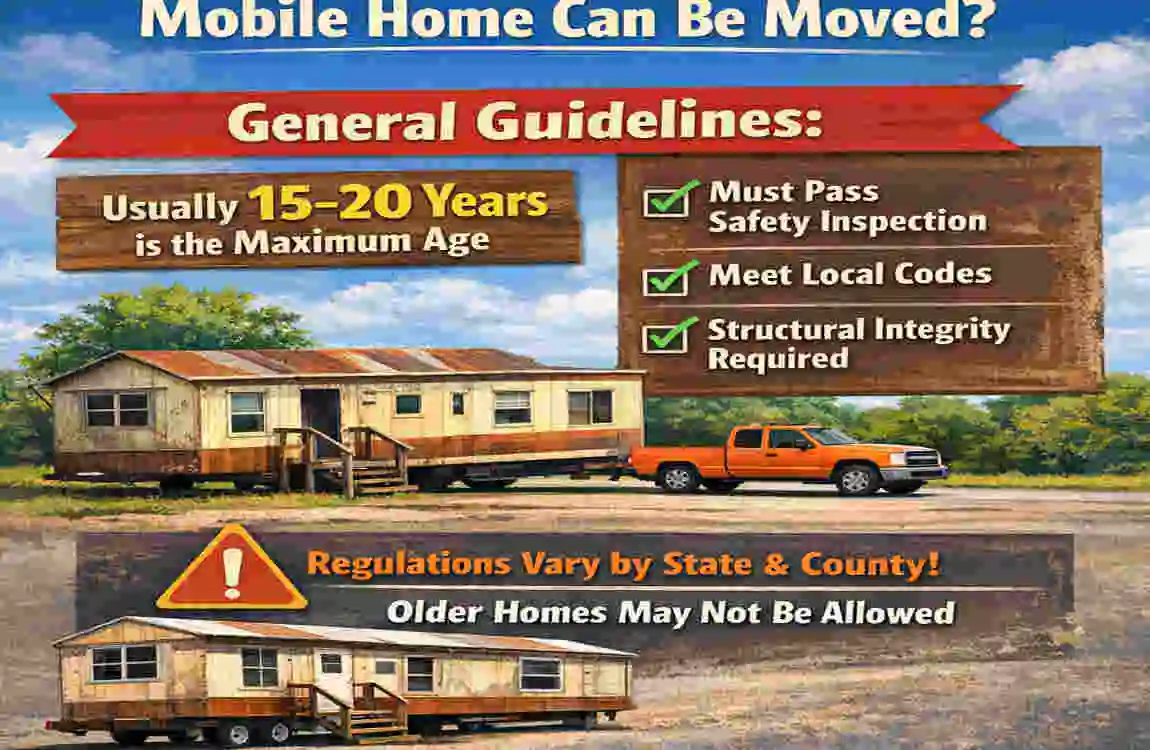
If you own a 25-year-old mobile home and you need to move it, you are probably asking the most important question first: What is the oldest age a mobile home can be moved? The short answer is that there is no single nationwide age limit. Still, many places use a 20-year benchmark, and some require that the home be post-1976 HUD code-compliant before it can be relocated.
That matters because the home’s age is not just a number on paper. It often affects whether the home passes inspection, whether a mover will accept the job, whether a park will allow it, and how much the move will cost. In many cases, the older the home, the more likely it is that the move will be denied or delayed.
If you are trying to relocate an old mobile home, this guide will walk you through the full picture in simple terms. We will cover the mobile home moving age limit, explain the role of HUD code mobile home transport, look at state and county differences, and show you what to expect with inspections, permits, costs, and alternatives.
Understanding the Age Limit for Moving a Mobile Home
The idea of a mobile home moving age limit can sound confusing at first because no one rule applies everywhere. Some states and counties focus solely on age. Others care more about condition, structural soundness, and whether the home meets HUD standards.
In practical terms, many movers and local authorities use 15 to 20 years as a common cutoff point. That does not mean every home older than 20 years is banned. It means older homes are much more likely to face extra review, more paperwork, higher repair costs, and a greater risk of refusal.
The reason age matters is simple. The older the home, the more likely it is to have worn-out materials, frame damage, roof issues, plumbing problems, or weak tie-downs. When a home is placed on the road, those issues can become serious safety risks.
That is why people who want to relocate old mobile home units need to think about age and condition together. A 30-year-old home that has been carefully maintained may be more movable than a 15-year-old home that has major damage. Still, local rules can override that common sense, so you always need to check before you make plans.
In the rest of this article, we will break the topic into clear sections so you can see what matters most and which steps to take next.
HUD Standards Basics: Why 1976 Matters So Much
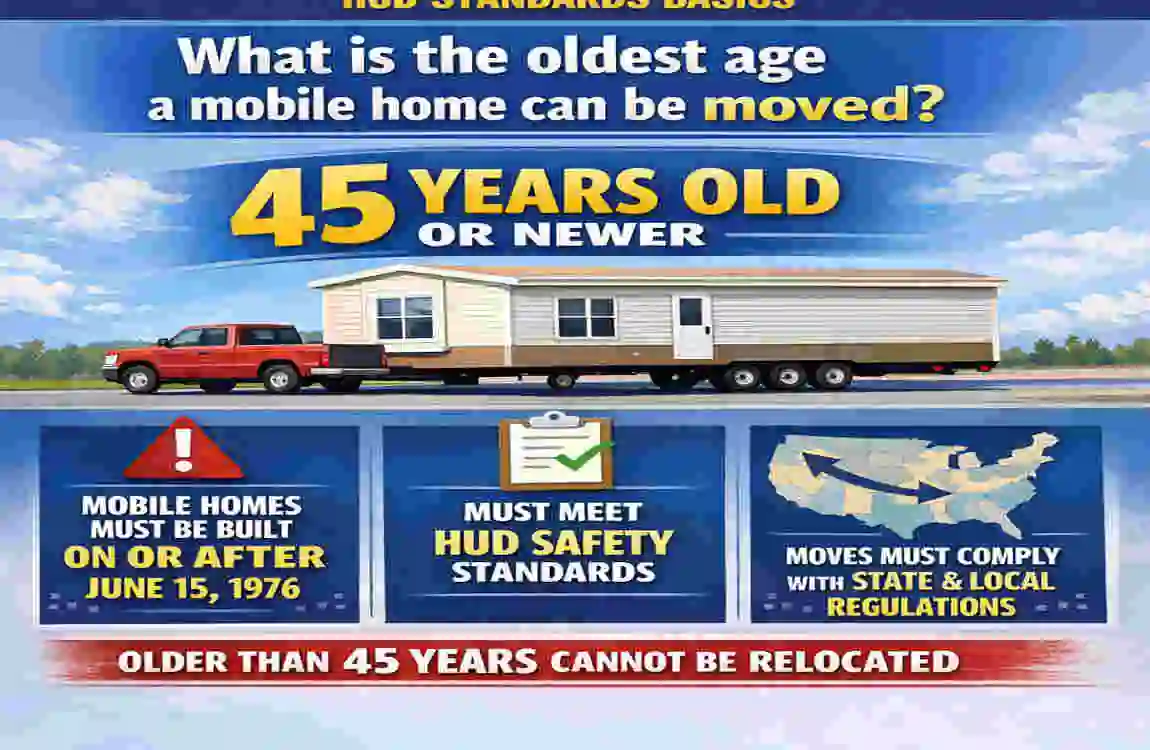
One of the biggest turning points in mobile home history came in 1976, when the federal HUD Code became the national standard for manufactured homes. That date is important because it distinguishes many older units from homes built to modern safety standards.
Before 1976, mobile homes were built under less uniform standards. Some were sturdy, but many lacked the safety features now expected in manufactured housing. After 1976, the HUD Code introduced stricter rules for things like structural strength, fire safety, wind resistance, and overall durability.
Why the HUD label matters
The HUD label acts like a stamp of compliance. It tells officials and movers that the home was built to federal manufactured housing standards. Without that label, proving the home is eligible for transport becomes much harder.
If you are planning HUD code mobile home transport, the label is one of the first things movers and inspectors will ask about. If the label is missing, damaged, or unreadable, you may need extra records or a special inspection to confirm the home’s status.
Federal baseline versus local rules
The federal government sets the broad safety framework, but states, counties, and even park owners often add their own rules. That means a home may be technically movable in one area and still be blocked in another.
A state may allow a post-1976 home to move if it passes inspection. At the same time, a park or a local zoning office may reject it for age or community policy reasons. This is why the answer to what is the oldest age a mobile home can be moved always depends on where the move is happening.
What this means in real life
If your home was built after 1976, you have a better chance of getting approval. That does not guarantee success, but it usually makes the process easier.
If your home was built before 1976, expect more questions. In many cases, the answer may still be no, especially for long-distance or cross-state moves.
HUD vs. Pre-HUD Homes: A Simple Comparison
Here is a simple side-by-side look at how homes built before and after the HUD Code are often treated.
Feature: Pre-1976 Homes, Post-1976 HUD Homes
Safety Standards: Minimal or inconsistent. Built to federal wind, fire, and structural rules
Movability: Often prohibited or heavily restricted. Possible if the home passes inspection.
Common Age Limit: Usually not based on age alone, but often too old to move. Often allowed up to 20–30 years, depending on location
Inspection Process: More difficult, more likely to fail. Standard inspection is usually required
Transport Approval: Often denied, often possible with permits and proof of condition.
This table gives you the basic idea, but it is important to remember that local rules still matter. A HUD-compliant home can still be denied if it is badly damaged, poorly maintained, or located in a strict jurisdiction.
Common Age Limits by State and Local Area
This is where things get more complicated. There is no federal maximum age for moving a mobile home, but many states, counties, and parks create their own rules. That is why one mover may say yes to the same home, while another may say no.
In many places, the practical limit is around 15 to 20 years, especially when the home is being moved into a mobile home park or through a permit process that uses age as a shortcut for risk.
Strict areas
Some states and local jurisdictions are known for stricter rules. In these places, homes older than about 20 years may be denied automatically, even if they look okay on the surface. This is especially common where park managers, local governments, or insurance carriers are cautious about older units.
In strict areas, age can act like a hard stop. That means the home may never even reach the inspection stage if it is too old on paper.
More flexible areas
Other places take a more practical approach. In those areas, a home older than 20 years may still be allowed if it is in good condition, has the right paperwork, and passes a full inspection.
This more flexible approach is often better for homeowners because it gives them a chance to prove the home is safe. Still, it usually means more documentation, more reviews, and possibly more repair costs before the move can happen.
County and park-level differences
Even within the same state, the rules can change from county to county or park to park. That means you may find one location that allows a 25-year-old home and another that rejects a 12-year-old home because of size, foundation type, or community policy.
This is why you should never assume that one approval means all approvals. The answer to what is the oldest age a mobile home can be moved may depend more on a local office than on a state law.
Regional patterns to keep in mind
Southeast
In the Southeast, a 20- to 25-year range is often seen in park policies and mover guidelines. Older homes may be rejected more often, especially if they show wear from humidity, storms, or frame rust.
West
Western states often focus more on condition than age, but that does not mean every older home is welcome. Reinspection fees, permit delays, and special local rules are common.
Other regions
In other parts of the country, the rules can be less predictable. Some places care mostly about the HUD label, while others focus on title records, zoning, and structural reports. The best approach is always to check with the county office, DMV, or housing department before you commit to a move.
Why Some Mobile Homes Are Denied Move Approval
A mobile home may be rejected for many reasons, and age is only one of them. In fact, a home can be turned down even if it is under the usual age limit.
These issues matter because moving a home is not like towing a regular trailer. A mobile home has to survive highway travel, turns, vibration, wind, and setup at the new site. If the structure is weak, the risk becomes too high.
So when people ask what the oldest age a mobile home can be moved is, the real answer is often this: the oldest movable home is the one that can still pass safety checks. Age is important, but condition often decides the outcome.
The Inspection and Approval Process
If your home seems eligible, the next step is usually an inspection and approval process. This is where the details matter.
A mover, local office, or park manager may want to see proof that the home is safe to transport. That usually means the home must be checked from top to bottom before anyone agrees to move it.
Find the HUD label and data plate.
Start with the basics. Look for the HUD label and data plate. These items help prove when and how the home was built.
If the label is missing, the process becomes harder, but not always impossible. You may need records from the manufacturer, title documents, or a verification service.
Hire an inspector
A licensed inspector can check the home’s structure, frame, roof, flooring, plumbing, and other important parts. Inspection fees often range from $200 to $500, though the price can be higher if the home is large, hard to access, or in rough condition.
This inspection is important because it gives you a clear picture of whether the home is a good candidate for HUD code mobile home transport.
Make needed repairs
If the inspector finds problems, you may need to fix them before the move can happen. Common repairs include:
- Replacing damaged floor sections
- Repairing rusted steel
- Sealing roof leaks
- Rebuilding weak frame areas
- Fixing broken skirting or underbelly material
- Replacing bad tie-down hardware
These repairs can add time and cost, but they may be necessary if you want the move approved.
Reinspect the home
After repairs, the home may need a second inspection. This is especially true if the first review found safety concerns.
That second check can feel frustrating, but it helps protect you. It also gives the mover confidence that the home will reach the new site without major problems.
Get permits and mover approval.
Once the home passes inspection, you still need permits. Some states require transport permits, route approval, or local utility coordination.
This is also where some movers draw the line. A mover may refuse to handle a home older than 20 years, even if the paperwork appears to be in order. That is often because they do not want the liability of moving a structure that could fail on the road.
Why inspections matter so much
Inspections are not just a formality. They are the main tool used to determine whether the home is safe enough to move into. If the home has hidden damage, transport can quickly become dangerous.
That is why older homes face more scrutiny. The older the home, the more likely it is that inspectors will look closely at every weak point.
What Inspectors Usually Look For
A mobile home inspector is not just checking age. They are checking whether the home is still structurally sound and ready for transport.
Common inspection points
Frame and chassis
The steel frame must be strong enough to carry the home during towing. Rust, bending, or welding problems can lead to failure.
Roof condition
A leaking roof can lead to more serious damage inside the walls or the floor. Water damage is a major red flag.
Floors and subfloor
Soft spots, sagging sections, or rot may indicate that the structure is not strong enough to withstand movement.
Walls and joints
Walls should be stable and properly attached. Cracks or separations can indicate that the home has shifted over time.
Underbelly and insulation
The underside of the home should be secure, because loose material can tear during transport.
Axles, wheels, and towing points
These parts must be ready for the road. If they are worn out or damaged, the move may be unsafe.
What happens if the home fails inspection?
If the home fails, you may still have options. In some cases, repairs can bring it up to standard. In other cases, the damage is too severe, and the move is no longer realistic.
That is why it is smart to inspect the home early, before you spend money on permits or moving contracts.
Cost to Move an Old Mobile Home
Cost is a major part of the decision. Even if the home is eligible, moving it can get expensive fast.
In many cases, the total cost to move an older home falls between $3,000 and $15,000, depending on the unit’s size, distance, repairs, and local requirements.
Cost breakdown
Factor Cost Range: How Age Affects It
Inspection $200–$800 Older homes often need deeper checks
Transport $2–$10 per square foot. Older homes may be refused or require special handling
Permits and Repairs $500–$5,000+ Older homes often need more prep work
Set up at New Site $1,000–$3,000. Older homes may need extra leveling or stabilization
The numbers above may vary depending on your location, home size, route, and condition. But the pattern is always the same: the older the home, the more likely the total cost is to go up.
Why older homes cost more
Older homes often need more than one round of work. You may pay for inspection, then repairs, then reinspection, then permits, then transport, then setup. If any step goes wrong, the budget can climb quickly.
Some movers also charge more for older homes because they see them as higher risk. If they believe the home may not survive transport, they may either raise the price or decline the job entirely.
Moving may not be worth it.
Sometimes the cost to move an older mobile home exceeds its value. In those cases, it may make more sense to sell it, donate it, or replace it with a newer home.
That can be a hard decision, but it is often the practical one.
Challenges of Moving an Older Mobile Home
The older the home, the more likely you are to face problems before, during, and after the move. These challenges are not just annoying. They can affect safety, cost, and whether the move happens at all.
Insurance issues
Insurance companies may be reluctant to cover older homes during transport. If the home is very old or has a poor maintenance history, finding coverage can be difficult.
Without insurance, many movers will not take the job.
Park rejection
If you are moving into a mobile home park, the park may have its own age rule. Some parks simply do not accept homes older than a certain number of years, regardless of condition.
This can be frustrating because the home may be movable in theory, but not allowed in practice.
Route and road concerns
A longer move means more time on the road, more vibration, and a greater chance of damage. Older homes are more likely to have weak points that fail under travel stress.
Utility and setup problems
Even after the move, the home may need extra work to reconnect utilities, level the structure, and make it safe for occupancy. Old homes often need more setup support than newer ones.
Emotional stress
There is also the personal side. Many people have a strong attachment to their mobile home, especially if it has been in the family for years. When the move becomes complicated, the process can feel overwhelming.
That is why planning matters so much. An early, realistic assessment can save time, money, and frustration.
Alternatives If Your Mobile Home Is Too Old to Move
If your home is too old to meet the mobile home moving age limit in your area, that does not mean you have no options.
Upgrade the home in place.
Sometimes the best move is not to move at all. You may be able to improve the home where it sits by fixing the roof, replacing floors, improving insulation, or updating the interior.
This can be a smart choice if the location is good and the structure is still usable.
Sell the home for parts or salvage.
If the home cannot be moved safely, it may still have value in parts. Salvage buyers may pay for metal, fixtures, doors, windows, or appliances.
That will not bring in a huge amount, but it can help recover some value.
Donate or transfer the home.
Some organizations or buyers may accept older homes for non-travel use, especially if they will stay on-site. This can be a useful option if the goal is to clear the property rather than make a profit.
Replace it with a newer home.
In many situations, replacing the old unit with a newer manufactured home is the cleanest long-term solution. Newer homes are easier to insure, easier to move, and more likely to meet current standards.
Request a professional assessment.
Before you decide, get a relocation assessment from an experienced mobile home moving company. Sometimes a home that looks too old still has enough structural life left to move. Other times, a quick inspection will save you from spending money on a move that was never going to work.
How to Prepare Your Home for a Possible Move
If you think your home might still qualify, preparation can improve your chances.
Simple preparation checklist
- Gather title papers, HUD label info, and purchase records
- Look for signs of frame rust or water damage
- Check the roof for soft spots or leaks
- Make sure skirting and underbelly materials are secure
- Remove loose items inside the home
- Inspect doors, windows, and cabinets for damage
- Ask a mover to review the route and permit needs early
The goal is to make the home as ready as possible before the first official inspection. The cleaner and more organized your records are, the easier the process becomes.
Why early planning helps
Many homeowners wait until the last minute to ask about moving into an older home. By then, they may already have a deadline, a new property, or a park notice.
That is risky. If the home turns out to be too old or too damaged, you may not have enough time to find another solution.
Planning early gives you more choices and more control.
Tips for Choosing the Right Mover
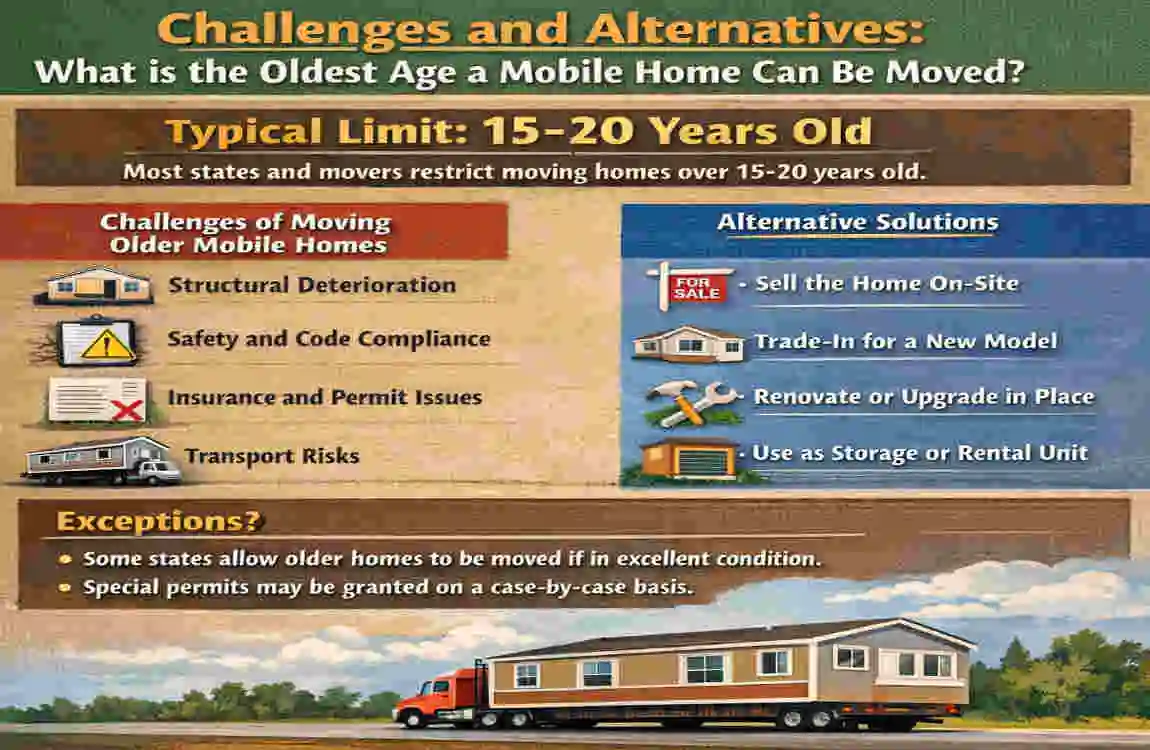
Not every moving company handles old mobile homes. Some companies only want newer units. Others specialize in difficult or older relocations.
What to ask before hiring
- Have you moved homes in the past 20 years?
- What inspections do you require?
- Will you help with permits?
- Do you offer route planning?
- What repairs must be completed first?
- Do you provide setup at the new site?
A good mover will give you clear answers. If they avoid your questions or promise a move without reviewing the home, that is a red flag.
Why experience matters
Older homes can be tricky. A mover with experience handling older units is more likely to spot problems early and avoid surprises later.
That can save you money and prevent damage.
Frequently Asked Questions
What is the oldest age a mobile home can be moved?
There is no universal age limit, but many areas use around 20 years as a common benchmark. Some places are stricter, while others allow older homes if they are post-1976 HUD-compliant and pass inspection.
Can a 30-year-old mobile home be relocated?
Yes, sometimes. A 30-year-old mobile home may still be relocated if it meets HUD requirements, has a sound structure, and has local approval. The big issue is not just age. It is whether the home is safe enough to move into and in compliance with local rules.
Are pre-1976 mobile homes movable?
Usually, not easily. Pre-1976 homes often fall outside modern HUD safety standards, so many movers and local agencies will not approve them for transport. In some rare cases, special approval may be possible, but it is not common.
Is the 20-year rule the same everywhere?
No. The 20-year rule is a common guideline, not a nationwide law. Some states, counties, and parks are more flexible. Others are stricter and may automatically deny older homes.
How much does it cost to move a 25-year-old mobile home?
Costs can vary widely, but older homes often need more inspection, repair, and setup work. Because of that, a 25-year-old home may cost more than a newer one, especially if it needs extra attention before transport.
What is the best way to know if my mobile home can be moved?
The best step is to schedule a professional inspection and check with your local permit office or mover. That gives you a realistic answer based on your home’s condition and your local rules.
